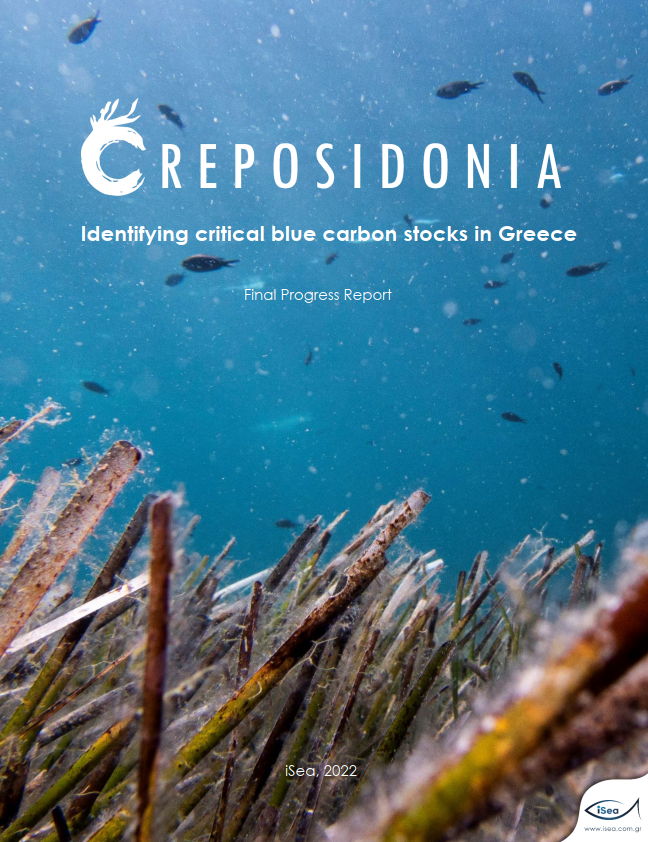
REPOSIDONIA: Identifying Critical Blue Carbon Stocks in Greece
REPOSIDONIA, is one of the main projects, that falls under the scope of the Vulnerable Species pillar of iSea.
It is an umbrella project that aims at the protection and the preservation of the priority habitat that P. oceanica constitutes, to the point it fulfils its ecological role in a healthy marine ecosystem through various ecosystem functions and services.
Through the REPOSIDONIA project, iSea aims to contribute to the management and protection of the P. oceanica seabeds in Greece, as it is one of the most important coastal habitats in the Mediterranean, providing nursery and hunting grounds for many species (Pergent et al. 2016), among other services.
To achieve this, the project has four main thematic units of activities
(i) increase the scientific knowledge about the distribution and area coverage of P. oceanica meadows in the Greek Seas
(ii) conduct biodiversity surveys and health assessments for the meadows
(iii) estimate the mapped meadows’ Blue Carbon potential to propose science-based management measures, and finally,
(iv) educate and sensitise key stakeholders to propose target management actions for these habitats, highlight the important ecosystem services offered by the meadows.
In this context, iSea has identified three main regions of importance for P. oceanica habitat:
Formicula island (Inner Ionian Archipelago);
Lemnos Island and Nisyros,
Gyali and surrounding islands.
These areas belong to the Natura2000 network designated as Sites of Community Interest (SCI) and Special Areas for Conservation (SAC). The drivers in pinpointing these areas derive from their similarities as the data of the habitat 1120 (Posidonia beds) is listed as “Poor” in the Standard Data Forms (SDFs), indicating that more research is needed, while the threats they receive are not sufficiently assessed or monitored (i.e. tourism, coastal development, pollution etc.).