
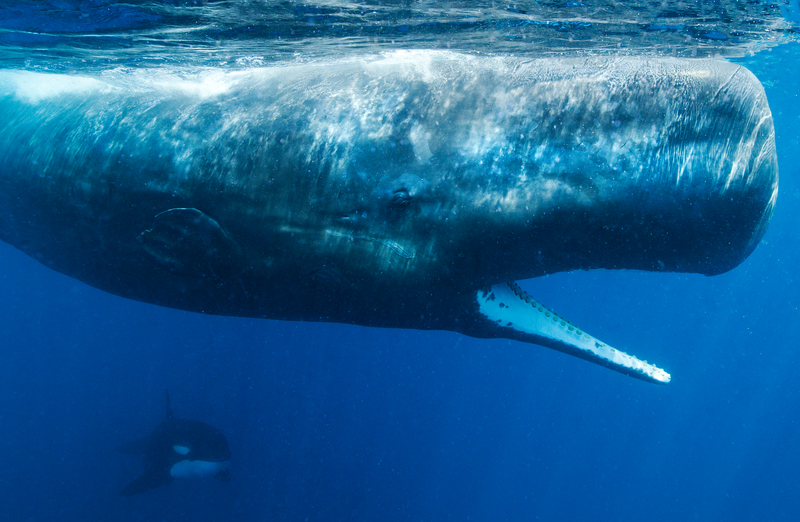
World Whale Day is celebrated on the third Sunday of February and was originally created in Hawaii to honor the region’s humpback whales. Over the past 40 years, it has evolved into an international day to celebrate all whales and raise public awareness of the dangers they face.
Whales are fascinating creatures. Some, such as the bowhead whale, can live for over 200 years. Whales can pass on their “culture” to other whales in the form of behaviors and songs—they are a species that relies on social learning, just like humans. They also play an essential role in maintaining the health of the oceans and mitigating the effects of climate change through their diet and position in the food chain. As a species, they are diverse and have a global distribution, from the the Arctic to the Mediterranean. In Greece, whales such as sperm whales and cuviers beaked whales and other cetaceans such as porpoises and dolphins can be found. These species are mainly found in the depths of the Hellenic Trench, a steep trench 5 km deep between the Eurasian and African tectonic plates, which is a biodiversity hotspot and a critical habitat for cetaceans and marine life. The trench has been designated an Important Marine Mammal Area (IMMA) by the IUCN, and part of it will be included in the new marine protected areas, in the Ionian and Aegean, announced by the Greek government.
While commercial whaling was once the greatest threat to whales, today the biggest threats are entanglement in nets, changes in the marine food chain, pollution, collisions with ships, and industrial activities such as fossil fuel extraction.
Its great depth makes the Greek Trench a fertile field for extraction, leading to the division and concession of plots for gas exploration and extraction. Licensing for the continuation and expansion of fossil fuel efforts in itselft runs counter to efforts to combat the climate crisis and prevent global warming. At the same time, the activity itself poses a critical threat to marine fauna and especially cetaceans. Seismic surveys accompanying drilling operations have been documented to have lethal effects on cetaceans, which rely on sound for their survival.
Protecting whales, their rich culture, their ecological functions, and their value to the natural environment means protecting their habitats, and therefore taking active measures to protect the marine environment, such as creating marine protected areas and abolishing harmful practices that are contrary to the effective protection of nature.