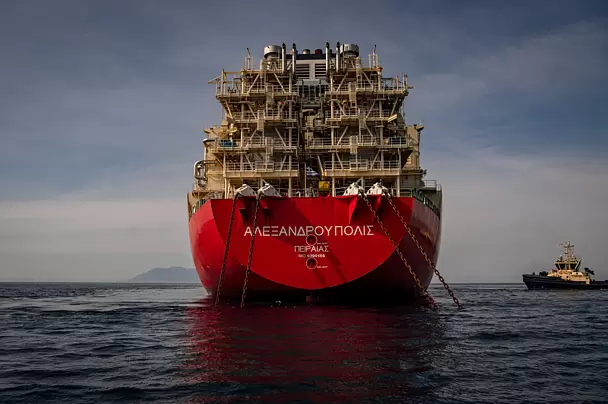
The market’s almost zero interest in gas transported through the Vertical Corridor shows the uncertain future of dependence on a particularly problematic fossil fuel. Unfortunately, the Greek economy is sinking into uncertainty and long-term economic dependence on the oil industry, without any plan or perspective, causing serious damage to unique and valuable marine ecosystems, such as the Thracian Sea.
The narrative that Greece can become an LNG hub is based mainly on circumstances rather than on solid economic or energy conditions. Therefore, the environmental organizations Hellenic Ornithological Society, Hellenic Society for the Protection of Nature, Greenpeace, MEDASSET, and WWF Greece express their strong concern about the following:
Environmental organizations are expressing concern about the complete lack of measures to implement the European Methane Regulation, which imposes some minimum mitigation, monitoring, and transparency measures.
The country’s dependence on fossil fuels and, by extension, on oil companies is a source of geopolitical instability, permanent environmental degradation, and serious consequences for the economy and society. Dependence on fossil fuels is not development — it is an economic, social, and environmental trap. Real progress lies in the strong institutional protection of valuable natural ecosystems, the transition to clean energy with strong guarantees of environmental protection and social participation and justice, and transparency and broad participation in the decision-making process.
As the Prime Minister emphasized a few days ago, opening the chapter on constitutional reform, “it is time to dare to make major changes that will strengthen the prestige of institutions and the confidence of citizens, introducing regulations for the better functioning of the political system in the face of the great challenges of our time and keeping pace with new developments, such as artificial intelligence and the climate crisis.” Policies that plunge future generations into dependence on environmentally destructive fossil fuels do not signal progress and concern for future generations, but a regression to fossilized ways of thinking that science itself tells us should be consigned to the dustbin of the past.
Environmental organizations emphasize once again that the best service to future generations and, at the same time, to strengthening the prestige of institutions and public confidence is legal certainty and the alignment of law and policy with scientific data and imperatives . Protecting nature and halting climate change are matters of urgent social interest that must be addressed as a matter of priority.
In December 2023, the environmental organizations Hellenic Ornithological Society, Hellenic Society for the Protection of Nature, MEDASSET, Greenpeace Greece, and WWF Greece filed an appeal with the Council of State to overturn the decision approving the environmental terms of the Alexandroupolis ASFA. The organizations argue that the project, which has been established within a marine protected area, should be canceled due to its serious impact, despite the fact that similar activities are prohibited within Natura 2000 areas. The environmental organizations are also requesting a judicial review of the impact of the activity on the unique and particularly vulnerable Mediterranean population of the monk seal, whose habitat is shrinking, and more generally point to the incomplete assessment of the impact on biodiversity (including fish populations in the area). In their appeal and additional arguments submitted to the Supreme Court, the organizations focus on the critical issue of the understatement of methane emissions, which is the most potent greenhouse gas. In addition, they ask the court to assess the increase in greenhouse gas emissions from the project, in accordance with the country’s commitments under national, EU, and international law.